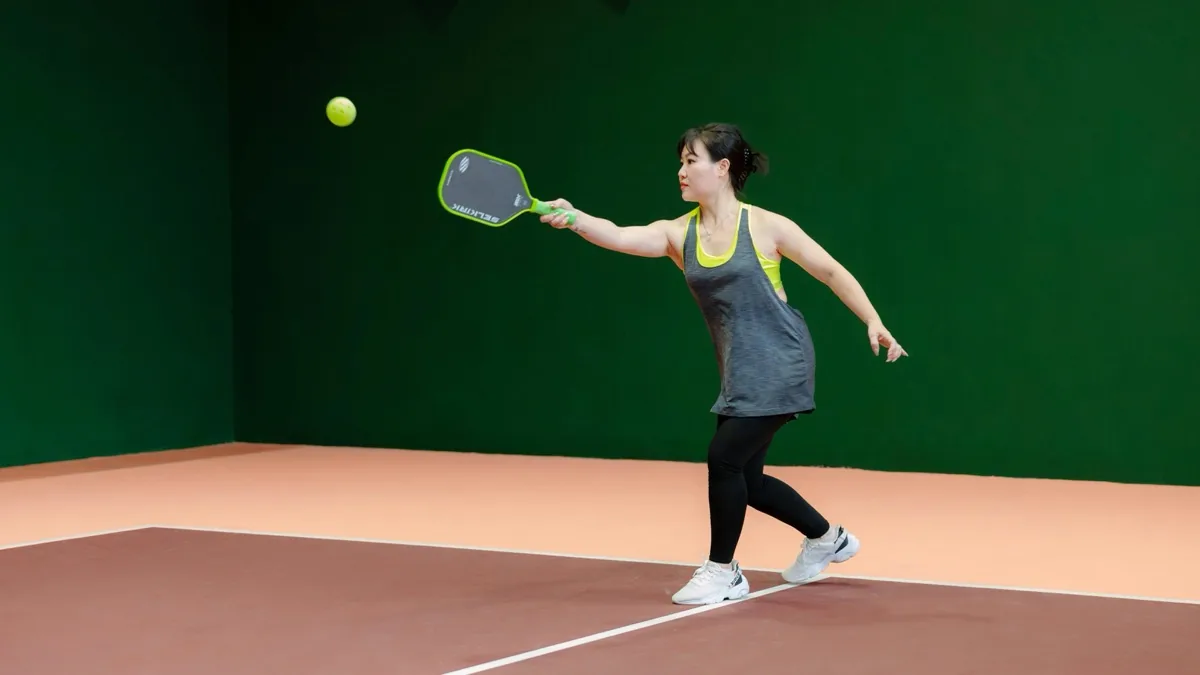
Indoor vs Outdoor: The Biggest Distinction
This is the first thing to understand. Pickleball balls are not universal. Indoor balls and outdoor balls are physically different objects designed for different surfaces and conditions.
Indoor Balls
Indoor balls are softer, lighter, and have larger holes (typically 26 holes). They play slower and are designed for gym floors and sports courts where there's no wind. The softer material creates a better feel for touch shots and dinking, which is why most indoor play uses them. They're also quieter, which matters in gyms where pickleball and other activities coexist.
Outdoor Balls
Outdoor balls are harder, slightly heavier, and have more holes (typically 40 holes, smaller diameter). The harder plastic handles rough court surfaces and the extra holes help the ball track straighter in wind. They're faster and noisier than indoor balls. If you're playing on asphalt or concrete, you need an outdoor ball — indoor balls crack quickly on rough surfaces and their softer material doesn't bounce consistently on hard courts.
Balls Beginners Should Consider
Here's a straightforward breakdown of the balls I'd recommend for someone just getting started, based on use case.
Outdoor: Franklin X-40
Price: ~$20-25 for a 6-pack
Best for: Outdoor hard courts, open play, leagues
The X-40 is the most commonly used outdoor ball in North American recreational and tournament play. It's the official ball of USA Pickleball and several major tournaments. For a beginner, this matters because you'll encounter it constantly at open play sessions and clinics — learning with the ball you'll actually play with in most settings makes sense.
The X-40 is durable for an outdoor ball, though it will still crack on rough courts over time. Budget 10-20 hours of play per ball on standard asphalt. It has a consistent bounce and handles wind reasonably well.
Outdoor: Onix Pure 2
Price: ~$20-25 for a 6-pack
Best for: Smooth outdoor courts, players who want a slightly softer feel
The Pure 2 plays similarly to the X-40 but with a slightly softer hit. Some beginners find it easier to control, especially for dinking and drop shots. It's used in some USAPA-sanctioned play and is widely available. Where the X-40 is the safe default, the Pure 2 is a reasonable alternative if you find the X-40 too hard or noisy.
Indoor: Onix Fuse
Price: ~$18-22 for a 6-pack
Best for: Gym floors, community center courts, any covered indoor surface
The Fuse is the most widely used indoor ball in recreational play. It's soft, has a good consistent bounce on gym floors, and is quiet enough not to cause issues in shared spaces. For beginners playing at a YMCA or community center, this is almost certainly what's already in the shared basket — and buying a pack to practice with at home or bring to drop-in makes sense.
Indoor: Gamma Photon
Price: ~$15-20 for a 6-pack
Best for: Indoor courts, players on a tighter budget
The Photon is slightly less common than the Fuse but plays well on indoor surfaces. It's a good option if you want an indoor ball that costs a bit less. The bounce is consistent and it holds up well for recreational play. At higher levels of play you'll see more Onix, but for beginners the Photon is fine.
What to Avoid
Generic unbranded balls from Amazon or discount sporting goods stores are almost always a mistake. They're often softer than standard, have inconsistent holes, and don't bounce true. I played with a pack for about two weeks before figuring out why my feel had gotten worse. The price difference between an unbranded 12-pack and a Franklin or Onix 6-pack is small enough that there's no reason to go generic.
Also avoid buying outdoor balls for indoor play or vice versa. Using an outdoor ball on a gym floor doesn't break anything, but the bounce characteristics are wrong and you'll develop bad habits around how hard you need to hit to get the right depth on shots. Get the right ball for your surface.
How Many to Buy and When to Replace
For recreational play, a 6-pack lasts a while. For outdoor balls on rough courts, expect cracking after 10-20 hours of play depending on the court texture. Indoor balls last longer because they're not hitting rough surfaces, but they do get soft and misshapen over time.
A practical approach: buy a 6-pack of the appropriate type, rotate through them during play (playing with the same ball the whole session wears it faster), and replace individual balls as they crack or go soft. Keep one or two spares in your bag.
Pickleball Central has a good ongoing breakdown of current ball options and specs that's worth checking when you're ready to compare specific models in more detail.
The Quick Decision
If you're playing outdoors on hard courts: get a Franklin X-40 6-pack. If you're playing indoors on a gym floor: get an Onix Fuse 6-pack. If you're doing both, get one pack of each — they're not interchangeable and you'll use both.
Don't overthink ball selection at the beginner stage. The most important variables early in your development are playing time and getting coaching or good partners. The ball matters, but picking a reputable brand from the right indoor/outdoor category is all you need to do. Save the ball nerd debates about seam construction and bounce height consistency for when you're playing at 4.0+.