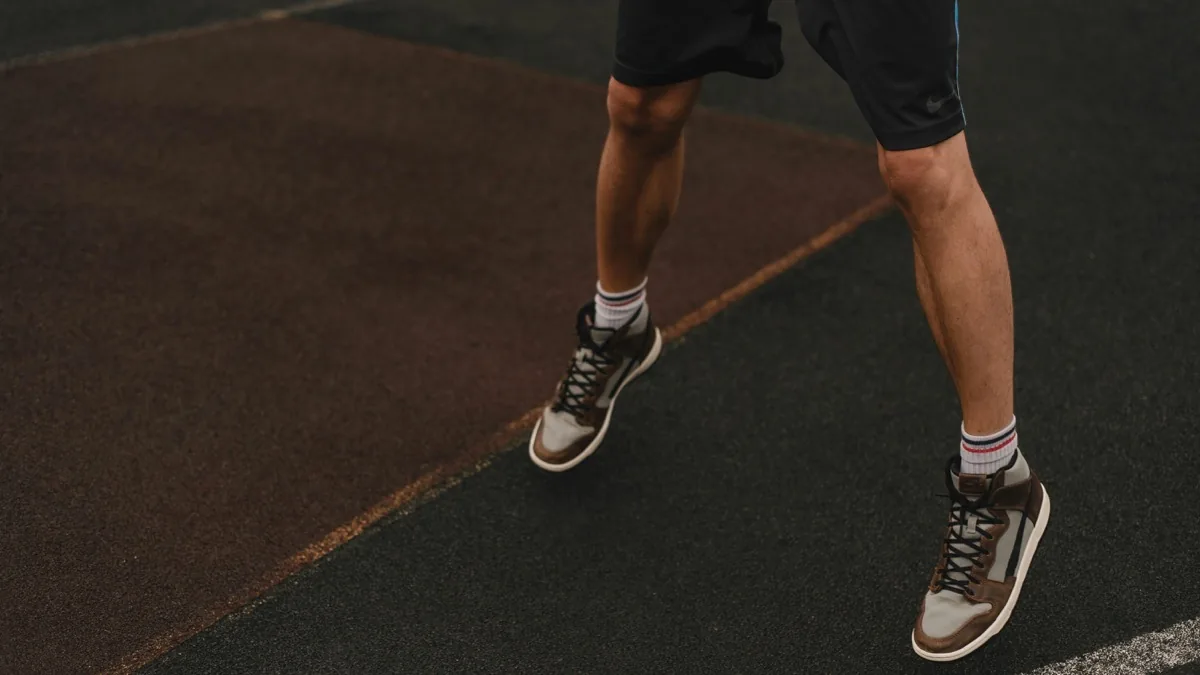
Why Running Shoes Feel Fine at First
Running shoes are comfortable. That is the whole thing. They have thick cushioning, decent arch support, and they feel great just standing around on a court. For the first few sessions, nothing seems wrong. You move, you swing, you run down a few balls, and you go home feeling fine.
The problem builds gradually. Pickleball involves a lot of lateral shuffling, quick direction changes, and sudden stops. Running shoes are built for forward propulsion. The sole is flexible in the toe-to-heel direction. When you cut sideways, there is almost nothing holding your foot stable. Your ankle compensates. Your knee compensates. Your hip compensates. Do this a few hundred times over several weeks and eventually one of those joints starts complaining.
Marcus had been playing for three years when he warned me. He said he made the same mistake when he started. His issue was ankle tweaks rather than knee pain, but same root cause. He switched after his second ankle roll. I, apparently, needed a physical therapist to convince me of something he figured out on his own in a parking lot.
What Lateral Support Actually Means in a Shoe
Dr. Kim explained it in terms I could follow. Lateral support comes from midsole stiffness on the outer edge of the shoe, reinforced upper construction along the sides, and a sole that resists rolling outward under load. Court shoes are designed specifically to resist that outward roll. Running shoes are not.
The American College of Sports Medicine emphasizes sport-specific footwear for injury prevention precisely because different movement patterns load joints differently. It is not just marketing language from shoe brands. The mechanics are real, and pickleball's side-to-side demands are about as different from running as you can get while still calling it aerobic exercise.
She had me try on a pair of New Balance Fresh Foam Lav shoes from a cabinet they kept for patient demonstrations. The difference was obvious immediately. When I pushed off sideways, my foot stayed planted rather than rolling. It felt like I was actually connected to the floor instead of balanced on top of something springy.
A Quick Store Test
If you are evaluating shoes at a shop, stand on one foot and press your weight outward, toward the little-toe side. In a running shoe, the sole starts to give. In a court shoe, it resists. Try a few lateral shuffles in the aisle. The shoe should feel planted, not wobbly. If you are sliding around inside the shoe, the fit is wrong regardless of the design.
What Changed When I Switched
I picked up a pair of ASICS Gel-Resolution 9s after my second PT appointment. Around $160 at a running specialty shop in Seattle. Dr. Kim had said that any dedicated court shoe from ASICS, New Balance, or Nike would be a meaningful upgrade over what I was wearing, and the Gel-Resolution happened to be in stock in my size.
The first two weeks felt a little stiff. Court shoes are stiffer than running shoes, and there is a genuine break-in period. I wore them around the house for a few evenings before taking them to a session. On the court, the difference in how I moved was noticeable right away. I was not slipping on quick direction changes. My knee did not flare up after a two-hour session the way it usually did.
By week six, the knee soreness was mostly gone. By week eight it had cleared up entirely and I stopped doing the morning exercises. I was actually moving faster after balls, not slower, because I was not subconsciously protecting the sore knee every time I planted and changed direction.
Marcus's reaction when I showed up with court shoes was something like "only took you six months." He was not wrong.
What to Actually Look For in a Court Shoe
You do not need to spend $200. But you do need to buy a shoe designed for lateral movement. Tennis shoes work perfectly well for pickleball because the sport has nearly identical movement demands. Basketball shoes are fine if you already have a good pair. Running shoes, trail runners, and generic cross-trainers are not adequate substitutes, even if they feel comfortable at first.
Sole pattern. Court shoes use a herringbone or modified multidirectional tread that grips in all directions. Running shoes have directional lugs or smooth foam that grips forward but slips sideways. Flip the shoe over and look at it. If the tread runs mostly in one direction, that shoe is not built for pickleball.
Toe box width. You want enough room that your toes do not jam into the front on forward sprints, but not so much room that your foot slides inside on lateral cuts. Feet swell during play, so buying slightly tight is a mistake.
Heel counter stiffness. Grab the back of the shoe and squeeze. A firm heel counter holds your foot in place on direction changes. If it compresses easily, look at a different option.
Since switching, I have also worn the Babolat Propulse and the New Balance 806, both solid. What they share is that none of them are running shoes. Start there and most other decisions become pretty forgiving.