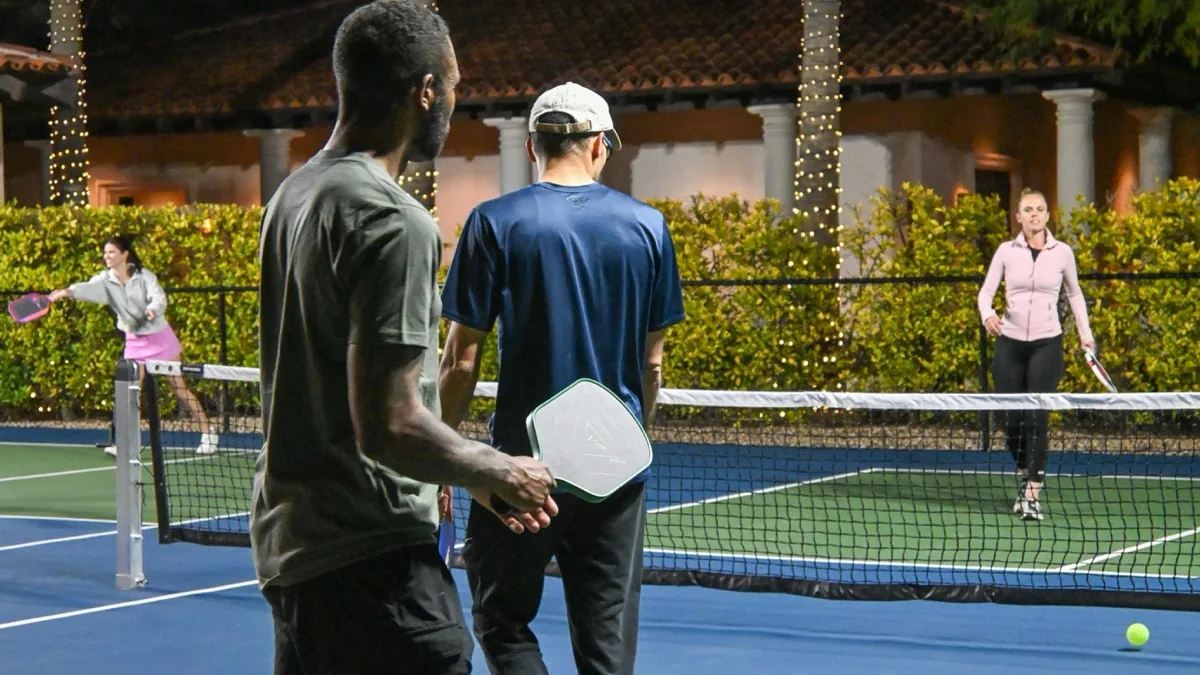
Basic Court Geography
Understanding court zones and their strategic purposes forms the foundation of good positioning throughout the match.
The Kitchen and Non-Volley Zone
The 7-foot non-volley zone controls net play. You can't hit balls in the air while standing in this area, but you want to position yourself as close to the kitchen line as possible for most points.
Baseline and Transition Zone
The area behind the kitchen but in front of the baseline is temporary space. Good players move through this zone quickly rather than setting up there permanently.
Net Advantages and Control
Controlling the net means controlling the match. The team that gets to the kitchen line first forces their opponents to hit up on the ball, creating attacking opportunities.
Doubles Positioning Fundamentals
Partner coordination and court coverage require specific positioning patterns that adapt to the flow of each point.
Side-by-Side Formation
When both partners are at the same depth (both at kitchen line or both at baseline), stay parallel and cover your half of the court. Avoid the temptation to crowd the middle.
Staggered Positioning
When one partner is forward and one back, the back player covers more court width while the net player focuses on putting away high balls and covering sharp angles.
Communication and Movement
Call 'switch' when crossing sides, 'mine' on balls in the middle, and 'help' when pulled out of position. Good communication prevents easy points from confusion.
Movement Patterns and Timing
Knowing when to move forward, back, or sideways requires reading your opponent's shots and anticipating the next exchange.
As USA Pickleball points out, footwork is often the most underrated part of the game.
Advancing to the Net
Move forward immediately after hitting a good drop shot or when your opponent hits a ball that lands short. Don't wait to see the result - start moving as you complete your shot.
Retreating for Defense
Back up when opponents hit passing shots down the line or lobs over your head. Stay balanced and prepare for the next shot rather than trying to run through balls.
Lateral Court Coverage
Shift left and right with the ball, but don't over-pursue wide shots. Sometimes it's better to let a difficult angle pass and reset for the next exchange.