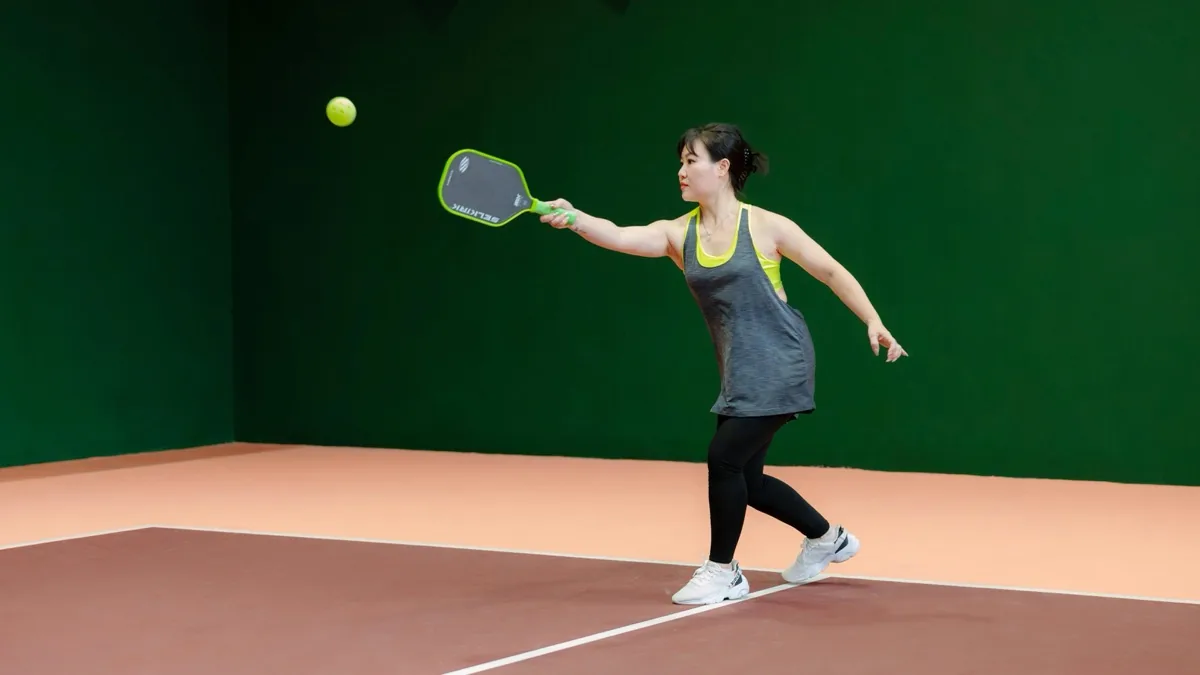
Why Cross-Court Beats Straight-Ahead
The geometry of pickleball makes cross-court dinks better in almost every way than straight dinks. The diagonal across the court is longer than the straight line down your side. That extra distance gives the ball more room to drop into the kitchen without sailing long. You can hit a slightly harder dink cross-court and still have it land in the legal zone, where the same shot down the line would clip the line or go out.
The net is also lower in the middle than at the sidelines. The net sags about two inches from the post to the center strap. Hitting cross-court means you are hitting over a slightly lower net, which gives you more vertical margin. Two inches does not sound like much, but on a shot where you are trying to skim the tape, that margin matters.
Then there is the angle itself. A cross-court dink pulls your opponent off the centerline of the court. If they have to step wide to handle the shot, the entire middle of the court opens up behind them. That is how points get set up. You are not trying to win the rally with the dink. You are trying to create space.
How Renata Set Us Up
I asked Renata more questions later that month and she walked me through what she and her husband were doing. The pattern was actually simple. They would start a dink rally with shots into our middle, harmless looking, just maintaining the rally. Then one of them would dink cross-court to whoever was on the side they wanted to attack. The next dink would go a little wider. Then wider. By the fourth or fifth ball, the player on that side was stepping into the alley to make contact, and the middle of the court was wide open.
At that point one of two things would happen. Either we hit a defensive dink that floated a little high, and they speed it up through the open middle, or we tried to dink back to the original side, which gave them a great angle into our partner. Either way, we lost the rally.
The genius of the pattern is that none of the individual shots looked dangerous. They were just dinks. The danger was in the cumulative effect of being pulled out of position over four or five shots in a row.
Hitting a Good Cross-Court Dink
The shot itself is not technically difficult, but a lot of players hit it poorly because they treat it like any other dink. A good cross-court dink has a few features that separate it from the basic version.
First, it lands deep in the kitchen, not just over the net. A short cross-court dink invites an aggressive forward step from your opponent. A deep one forces them to reach down and out, which is exactly the awkward body position you want them in.
Second, the contact point is in front of your body, not beside you. Players who let the ball get too close end up pushing it across with their wrist, which gives a flat, predictable shot. Stepping into the ball with your front foot and contacting it in front lets you control the angle and pace.
Third, the angle is wider than feels comfortable at first. New players hit cross-court dinks that barely cross the centerline. The whole point is to create distance between your shot and the opponent. Aim for the opposite sideline area of the kitchen, not the center.
The Paddle Face Trick
One thing my regular partner Marcus Holt showed me that took my cross-court dinks from okay to dangerous was the paddle face angle at contact. Instead of squaring the paddle to the net, he opens the face slightly toward the cross-court direction. The same swing path produces a much sharper angle. It feels strange at first because the shot wants to slide off the face, but with practice the ball goes exactly where you intended.
What Stops a Cross-Court Game
Knowing how to attack cross-court is half of it. The other half is knowing how to defend against it. After my losses to Renata, I spent a few months working on this with Marcus and another regular partner, Wendy Park. Wendy is one of those players who never seems to get pulled out of position no matter how wide the dinks go.
Her main trick is footwork. She moves to the ball with small adjustment steps rather than big lunges. When her opponents try to pull her wide, she covers the ground without committing her body weight outside the sideline. Her paddle stays in front of her, her shoulders stay square to the net, and she can recover to the middle within one step.
The other thing she does is hit her own cross-court dinks back. Instead of returning straight down the line, she reverses the angle and pulls her opponent wide on the opposite side. This breaks the pattern. The team trying to run the cross-court game suddenly has to defend instead of attack, and the rhythm of the rally shifts.
Reversing cross-court dinks is harder than it sounds. The ball is coming at you on a sharp angle, and the natural shot is back along the same angle. Reversing it requires opening your stance, contacting the ball earlier, and pushing it across your body. I drilled this for weeks before I could do it consistently in a real rally.
Drills for Cross-Court Dinks
The best drill I know for cross-court dinks is also the simplest. Two players, both at the kitchen line, dink only cross-court for five minutes straight. Every ball must land in the kitchen on the diagonal. No straight dinks, no speed-ups, no resets. Just cross-court.
The first time I tried this with Marcus we could not maintain a rally past four or five balls. The angles felt awkward. The pace was wrong. By the third week of doing the drill twice a week we were rallying past 30 in a row, and the muscle memory had built up to where the shot felt natural in matches.
The next progression is to add specific targets. Mark the deep corner of the cross-court kitchen with a cone. Try to land your dinks within two feet of the cone. This forces the deep, wide placement that creates real pressure rather than just maintaining the rally. Per a useful breakdown from Pickleballerie, dink targets work best when placed at the intersection of the kitchen line and sideline.
When Not to Go Cross-Court
Cross-court is not always the right answer. Against a strong cross-court reverser like Wendy, dinking everything diagonally just gives her chances to flip the pattern on you. Against a player who shades heavily toward the middle, a straight dink to the wider side might actually be more open than the cross-court option.
The general guideline I use now is to default to cross-court when in doubt, but pay attention to where the opponent is standing. If they are leaning cross-court in anticipation, a straight dink to the open space is the higher percentage shot. The pattern matters more than any individual ball. You are setting up the next two or three shots, not just hitting this one.
The Bigger Picture
Losing those three matches in a row was annoying at the time but probably the most useful pickleball experience of that whole year. It forced me to stop thinking about dinks as defensive holding patterns and start thinking about them as offensive setups. Every dink should be doing something. Every dink should be pulling the opponent out of position, opening up space, or breaking the rhythm of their pattern.
I still play Renata and her husband regularly. We split matches now, which is the best I can say. Marcus and I run our own cross-court patterns against them, and we have to be ready when they reverse the angles back at us. The kitchen game gets a lot more interesting when both teams are running real strategies instead of just trying to keep the ball low.