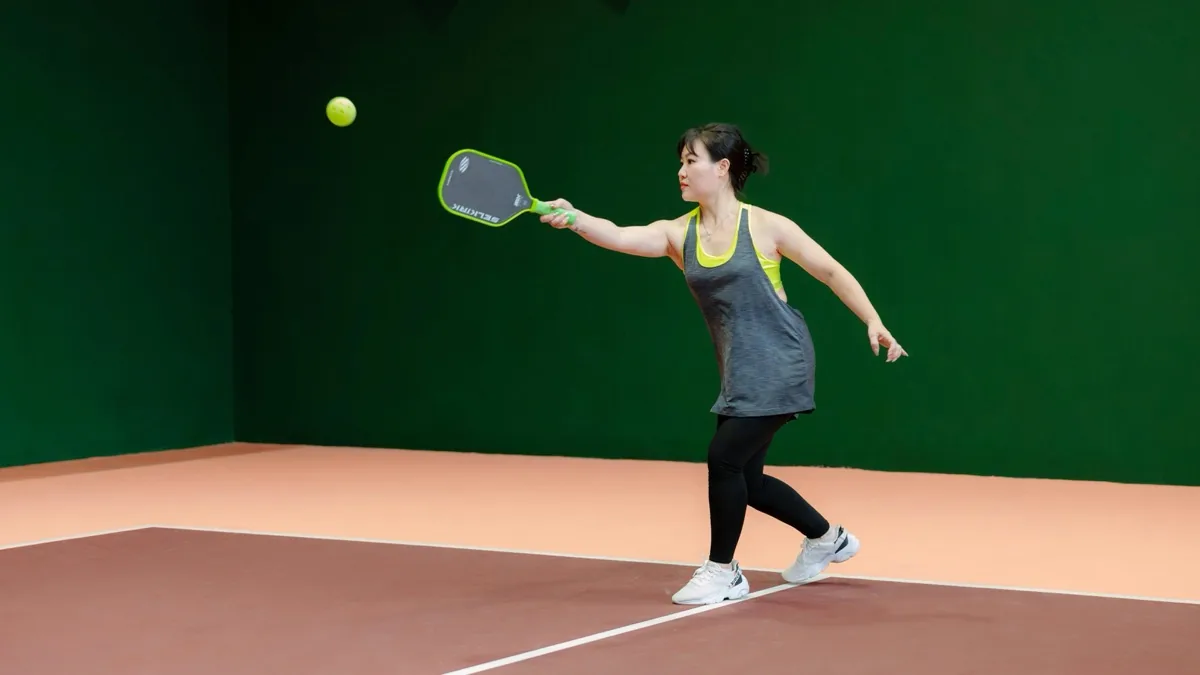
What a Topspin Serve Actually Does
A topspin serve has the ball rotating forward as it travels. The spin pulls the ball down faster than gravity alone would, which means you can swing harder and still keep it in the box. When the ball lands it kicks up and forward instead of bouncing predictably. A clean topspin serve makes the returner reach up or take it on the rise, and that is where most return errors come from.
The other benefit is psychological. Once a returner has seen one good topspin serve, they back off the baseline a step or two. That extra step gives you more time on your third shot and changes the entire point.
The Grip and Stance
I use a continental grip for my topspin serve, which is basically the same grip I use for a regular forehand. Some players go to a slight eastern grip to get more wrist roll. Try both and see what feels natural. Do not change anything else until you have settled on a grip.
For stance, I stand sideways to the baseline with my non-dominant foot forward. My feet are shoulder width apart and my weight starts on my back foot. The toss happens slightly in front of my body, not directly above my head. That forward toss is what lets me brush up the back of the ball.
Where the Ball Drops
I drop the ball from about waist height with my non-paddle hand, releasing it so it falls to a contact point right around hip level. You cannot toss it up like a tennis serve since the rules require the ball to be struck below the navel for a traditional serve, and even with the drop serve allowance you still want a low controlled drop. The ball should drop straight down without any spin from your hand.
The Swing Path
This is the part that took me forever. The swing for a topspin serve goes from low to high, with the paddle face brushing up the back of the ball at contact. I tell people to imagine you are trying to flick the ball up and forward at the same time. The face of the paddle stays roughly perpendicular to the ground, but the path of the swing is angled upward.
My biggest mistake early on was trying to get spin by rolling my wrist at contact. Do not do that. The wrist stays mostly firm, and the spin comes from the upward swing path and the brushing motion. Wrist rolling produces inconsistent contact and a lot of net errors.
Drills That Actually Helped
I worked with my friend Carlos Mendez on these drills for about six weeks. He had been hitting topspin serves for years and helped me see what I was doing wrong. The drills below are what actually moved the needle for me.
The Half-Court Drill
Stand at the baseline and try to land your topspin serve in just the front half of the service box, the part closer to the net. This forces you to get the ball to dip and lose its rigidity. If you can land 7 out of 10 in the front half with topspin, you are ready to start hitting deeper targets.
The Bounce Test
Have a partner stand behind the service box and watch the bounce. A real topspin serve will kick forward and stay relatively low. A flat serve will sit up. If your partner says your bounces look the same as a flat serve, you are not generating actual spin and need to work on the brush motion more.
Common Mistakes and How to Fix Them
I have helped maybe a dozen people learn this serve at our public courts on weekends, and the same three mistakes show up over and over.
First, hitting the ball too far out in front. People try to lean into it like a tennis groundstroke and they miss the ball entirely or pop it up. Keep the contact point closer to your hip, not way out in front of you.
Second, not following through. The follow through on a topspin serve goes up and across your body, finishing somewhere near your opposite shoulder. A short choppy follow through kills your spin and your power.
Third, going for too much spin too early. When I first tried this serve I was so focused on creating spin that I lost all my placement. Get the ball in the box first. Worry about spin amount later. A serve that lands in with mild topspin is infinitely better than one that hits the net with great spin.
When to Use It in a Match
I do not hit topspin serves on every point. Mixing it with my flat serve and an occasional slice keeps the returner guessing. I tend to use the topspin serve on the deuce side most often, aiming wide and pulling the returner off the court. On the ad side I save it for big points where I want to put extra pressure on the return.
The USA Pickleball official rulebook covers serve mechanics in section 4 if you want to read the technical requirements, available at usapickleball.org/what-is-pickleball/official-rules. I read it once a year just to make sure I am still doing things legally.